As the fourth quarter progresses and production targets for the year come into focus, most maintenance and engineering teams are thinking about two things: finishing 2026 without an unexpected shutdown, and making sure 2027 does not start with one.
The year-end window is more than a budgeting exercise. It is one of the few times when planned downtime, capital allocation discussions, and maintenance planning all converge. Used well, it is an opportunity to identify the industrial electronics most likely to fail in the coming year. Acting before production pressure arrives makes every option less expensive and less urgent.
This guide provides a practical framework for evaluating the condition of your critical industrial electronics. It includes seven diagnostic questions and a scoring tool for each asset. Equipment-specific inspection points and an action plan round out the framework.
Why a Year-End Reliability Assessment Matters
Variable frequency drives, PLCs, servo drives, HMIs, power supplies, and control boards often operate continuously for years under demanding conditions. Many provide reliable service well beyond their expected service life. Age, environmental stress, and normal wear gradually change the risk profile of those assets. Visible symptoms often do not appear until the moment of failure.
A structured assessment changes the dynamic. Your maintenance team identifies the highest-risk equipment while options are still available, rather than discovering problems when they cause production stoppages. You can schedule repairs during planned downtime, build targeted spare inventory, and make capital decisions based on known risk.
The goal is not to replace every aging component. It is to understand which assets are most critical and which are approaching the threshold where failure becomes a real risk. That understanding is what turns a maintenance team from reactive to proactive.
Seven Questions Every Maintenance Team Should Ask
Apply these seven questions to every critical electronic asset in your facility. The answers form the basis of your risk assessment and your action plan for the coming year.
1. How Old Is the Equipment?
Age is not a direct predictor of failure, but it is a meaningful risk factor. Industrial electronics accumulate heat cycles, vibration stress, and capacitor aging over time. Equipment in service for more than 10 years without a preventive evaluation carries more risk. The same equipment inspected and serviced regularly has a lower and better-understood risk profile.
Review the installation date, estimated hours of operation, production cycle count, operating environment, and prior repair history for each asset. Equipment in harsh environments ages faster. A unit with prior repairs has a known partial history; one that has never been serviced has an unknown one.
2. Is the Equipment Still Supported by the OEM?
OEM support status changes the risk profile of a failure event significantly. Fully supported equipment can typically be recovered through OEM channels with a defined lead time and known replacement cost. Discontinued or end-of-support equipment introduces uncertainty on multiple dimensions when it fails: replacement availability, firmware compatibility, programming migration, and engineering time.
Determine whether the OEM currently provides technical support, firmware updates, replacement parts, and new replacement units for each asset. Flag any component that is discontinued or within two years of announced end of support for priority attention in your assessment. For a full framework on what happens when OEM support disappears, see The Hidden Costs of OEM Discontinued Products.
3. Has the Equipment Experienced Repeated Faults?
Fault history is one of the most reliable predictors of imminent failure. A single fault that clears on reset and never recurs is different from a fault that resets and returns. Recurring faults, even at low frequency, indicate a developing condition. Left unaddressed, developing conditions become failures on their own schedule rather than yours.
Pull the fault history log for every critical VFD, servo drive, and PLC in your facility. Look specifically for recurring overcurrent events, overtemperature alarms, communication errors, encoder faults, and intermittent shutdowns. Document the frequency and pattern of any recurring fault. A fault that appeared twice last quarter and four times this quarter is accelerating, not stable.
Detailed coverage of how specific fault codes signal developing problems is available in The Most Expensive PLC Failures We See and the Fault Code of the Month series.
4. Are Critical Components Showing Signs of Wear?
Many electronic failures originate in components with known wear characteristics. Electrolytic capacitors degrade over years of thermal cycling. Cooling fans develop bearing wear that reduces airflow before they stop entirely. Display backlights dim progressively before they fail. Battery-backed memories lose their charge gradually before a power event exposes the loss.
Inspect each asset physically during the assessment. Check cooling fans for airflow and bearing noise. Look for swollen or leaking capacitors on visible circuit board areas. Verify that display backlights are at full brightness. Test batteries in any PLC or HMI that uses battery-backed memory. Inspect terminal blocks, connectors, and heat sink fins for corrosion or contamination. Replacing these wear items during scheduled maintenance is consistently less expensive than responding to their failure during production.
5. Do You Have a Tested Spare?
A spare on the shelf provides no protection if its condition is unknown. One stored for five years in variable conditions, never tested, and never verified for firmware compatibility is an assumption, not an asset. When a failure occurs, discovering the spare does not work adds time and cost to an already expensive event.
For each critical asset, confirm whether a tested spare exists and whether its firmware version is compatible with the installed equipment. Verify that drive or PLC parameters have been backed up to an accessible, verified file. Confirm the spare has been stored under appropriate conditions. Untested or unverified spares should be evaluated as part of the year-end assessment, not assumed ready.
6. What Would a Failure Cost?
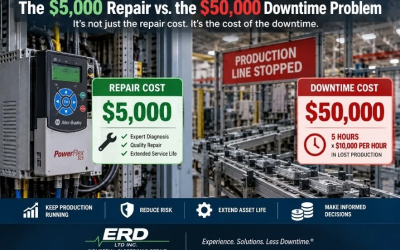
Most facilities underestimate the true cost of an unexpected electronic failure because the calculation stops at the replacement hardware price. The hardware is usually the smallest line item. Lost production, overtime labor, emergency freight, contract engineering support, and restart time all accumulate during an unplanned failure event. Collectively, they dwarf the cost of the component itself.
Calculate a realistic downtime cost per hour for each production line. Multiply by the realistic time to restore operation after a failure, accounting for sourcing, repair or replacement, and restart. For most facilities, this calculation reveals that even one unplanned failure on a critical asset costs more than a full year of preventive maintenance on that asset. The ROI framework for repair decisions specifically is covered in Industrial Electronic Repairs That Pay for Themselves.
7. Is Repair a Better Investment Than Replacement?
Before approving a replacement purchase for aging equipment, evaluate the repair option with complete information. Professional repair typically costs significantly less than replacement hardware. Repair preserves existing programming, parameters, and system integration. Turnaround is often faster than the replacement lead time, particularly for discontinued or legacy equipment. For equipment that is discontinued with no direct replacement, repair may be the only option that avoids a full engineering redesign.
The full comparison includes repair cost, replacement cost, lead time, installation requirements, programming migration effort, and remaining useful life. When all factors are in the calculation, repair is usually more competitive than the hardware price alone suggests. See Why More Manufacturers Are Choosing Repair Over Replacement in 2026 for the full framework.
Reliability Assessment Scorecard
Use this tool to score each critical electronic asset. Assign a point value of 1 for low risk, 2 for moderate risk, and 3 for high risk in each category. Add the scores to determine the overall risk level for each asset.
| Assessment Area | Low Risk (1 pt) | Moderate Risk (2 pts) | High Risk (3 pts) |
|---|---|---|---|
| Equipment Age | Less than 7 years | 7 to 15 years | More than 15 years |
| OEM Support | Fully supported | Limited support | Discontinued |
| Fault History | No recurring faults | Occasional faults | Frequent or escalating |
| Spare Availability | Tested spare on hand | Untested spare only | No spare available |
| Environment | Clean, climate controlled | Moderate dust or heat | Harsh environment |
| Component Condition | Excellent | Normal wear visible | Significant wear or damage |
| Downtime Impact | Minimal | Moderate production impact | Production-critical |
Interpreting Your Score
Low Risk: 7 to 11 points. Continue routine preventive maintenance and annual inspection. No immediate action required beyond scheduled upkeep.
Moderate Risk: 12 to 17 points. Schedule preventive repairs, replace aging wear components, and review spare inventory before year-end. Do not defer action past the next planned shutdown window.
High Risk: 18 to 21 points. Prioritize repair or replacement planning immediately. Obtain a tested spare, perform a complete physical evaluation, and develop a contingency plan before the next production cycle. Waiting until a failure occurs on a high-risk asset converts a manageable cost into an emergency.
Equipment That Should Be Assessed Every Year
The following categories of industrial electronics carry the highest consequence when they fail. Each deserves an individual scorecard evaluation, not a general category review.
Variable Frequency Drives
VFDs control pumps, conveyors, fans, compressors, and production machinery throughout most industrial facilities. A failed VFD typically stops the process it controls immediately. Common platforms requiring annual assessment include Allen-Bradley PowerFlex, Siemens SINAMICS, ABB ACS Series, Danfoss VLT, and Yaskawa drives. Inspection priorities are cooling system condition, DC bus capacitor health, fault history log, and power section physical inspection.
PLC Systems
PLCs are the logic core of automated production systems. A failed processor or critical I/O module can stop an entire line. Annual assessment should cover battery condition, program backup status and accessibility, and communication module fault history. Spare processor availability and the OEM support status of the specific PLC family should also be reviewed.
Servo Drives and Motion Controllers
Motion systems require the highest degree of precision and the most accurate feedback to operate correctly. Degradation in a servo drive or controller typically appears first as positioning drift or intermittent encoder faults. A hard fault follows later. Annual inspection should cover cooling fans, encoder cable condition, connector integrity, and fault history. Internal power component visual inspection should occur during any planned shutdown.
HMI Panels
Operator interfaces are frequently deprioritized in assessments because they appear to be functioning normally when display degradation is gradual. A failed HMI during a fault event leaves the maintenance team without the diagnostic tools they need. That happens at exactly the wrong moment. Assess display brightness uniformity, touchscreen calibration accuracy, and backlight condition. Verify communication reliability to the connected controller and confirm that application file backups are accessible.
Industrial Power Supplies
Power supplies degrade silently. Output voltage drift and increasing ripple occur long before complete failure. They produce erratic behavior in the PLC and I/O systems they feed that is difficult to attribute correctly. Annual assessment should include output voltage measurement against specification, capacitor condition inspection, cooling system verification, and thermal performance evaluation.
Build Your Reliability Improvement Plan Before Year-End
Assessment findings without action produce no benefit. Once you have scored your critical assets, the improvement plan follows directly from the results.
High-risk assets require immediate action. Schedule professional evaluation during the next planned shutdown. Identify repair or refurbishment options now, before failure pressure makes the decision for you. Confirm at least one tested spare exists for each high-risk asset. If not, initiate acquisition and testing before year-end.
Moderate-risk assets require scheduled attention. Plan preventive repairs during the next available maintenance window. Replace known wear items, including cooling fans, batteries, and aging capacitors, before they become failure events. Verify and refresh program and parameter backups.
All assets benefit from documentation discipline. Back up all PLC programs, HMI application files, and drive parameter sets before year-end. Verify that the backup files are accessible, readable, and stored in multiple locations. A program that cannot be retrieved from backup when needed provides no value.
Review the OEM lifecycle status of every critical platform before finalizing your maintenance budget. Components approaching end of support need a proactive strategy. Options include a spare acquisition plan, an established repair relationship, or a defined migration timeline. Waiting until end of support arrives creates the same emergency pressure as waiting for a failure.
For a component-by-component inspection framework to execute during a planned shutdown, see our September Shutdown Checklist for Maintenance Managers.
Start 2027 with ERD as Your Repair Partner
ERD Ltd. Inc. has been repairing critical industrial electronics since 1995. From our engineer-owned facility in Kernersville, North Carolina, our team provides component-level diagnosis and repair of VFDs, PLCs, servo drives, HMIs, and power supplies. Motion controllers, CNC control boards, RF generators, and industrial circuit boards from Allen-Bradley, Siemens, ABB, Danfoss, Yaskawa, Mitsubishi, Fanuc, Schneider Electric, and many other manufacturers are also within our scope, including legacy and discontinued platforms.
Every repair begins with root cause diagnosis. Repairs are tested under load and returned with all original parameters intact. Every repair is backed by our 3-year warranty, the strongest in the industry. When your assessment identifies high-risk components, ERD can evaluate them and tell you what needs attention. Units are returned tested and ready for production before year-end demands increase.
Have components that scored moderate or high risk on your assessment, or equipment you want professionally evaluated before year-end? Submit a repair request or contact our team now. Acting before a failure converts a manageable maintenance decision into a production emergency.
➤ Submit a Repair Request ➤ Contact ERD Today
Further Reading
- September Shutdown Checklist for Maintenance Managers: a component-by-component inspection framework for executing the physical assessment portion of this guide
- Industrial Electronic Repairs That Pay for Themselves: the ROI framework for question 7 of this assessment, with a step-by-step cost comparison tool
- The Hidden Costs of OEM Discontinued Products: what happens when a component scores high on OEM support status in your assessment
- Why More Manufacturers Are Choosing Repair Over Replacement in 2026: the strategic context behind repair-versus-replace decisions in the current supply chain environment
- The Most Expensive PLC Failures We See: the failure modes that fault history assessment is designed to catch before they become emergency events