
Programmable Logic Controllers are the operational core of modern industrial automation. They control conveyors, packaging lines, water treatment systems, CNC machines, robotic cells, and entire manufacturing processes. When a PLC fails, production stops. Not slows. Stops.
At ERD, we have been repairing industrial electronic assemblies since 1995. Over the decades, one pattern repeats consistently. The cost of a PLC failure is almost never limited to the cost of the PLC itself. Lost production, emergency shipping, overtime labor, missed deliveries, and engineering support typically dwarf the repair expense itself. The invoice we send is often the smallest item on the facility’s total cost sheet for that event.
Here are seven PLC failures we see most often, why each is as expensive as it is, and what facilities can do to reduce their exposure.
Why PLC Failures Are Rarely Just a PLC Problem
Most facilities calculate repair cost when a PLC fails. Very few calculate downtime cost, and that is where the real number lives. At facilities running high-value production, one hour of downtime can exceed the cost of repairing the PLC several times over. Production rates of $10,000, $30,000, or $100,000 per hour mean the speed of resolution matters far more than the price on the repair order.
Additional costs accumulate quickly: lost production output, missed customer shipments, overtime labor, emergency freight, and contract engineering support. Machine restart and functional testing time add further. Not one of those items appears on a repair invoice. None of those appear on a repair invoice. All of them appear in the actual cost of the event.
The facilities with the lowest total downtime cost are not necessarily the ones with the best PLCs. They identified failure risks early, maintained tested spares, and had repair relationships in place when something went wrong.
1. Power Supply Failure
Power supply failure is the most common PLC failure mode we see, and it is also among the most disruptive. The power supply is the foundation of the entire control system. When it fails, everything it feeds goes down simultaneously: processor, I/O rack, communication modules, and all downstream devices.
The most common causes are aging electrolytic capacitors that degrade over years of thermal cycling and voltage spikes that stress input protection components. Lightning events that overwhelm surge protection are also frequent. Excessive heat inside control enclosures accelerates component aging across the entire assembly.
What makes power supply failures expensive is their suddenness. There is typically no gradual performance degradation that operators notice before the system goes dark. The power supply works until it does not. A facility without a tested spare and a repair relationship is starting from zero at the worst possible moment.
What It Means for Your Operation
Inspect PLC power supplies during every planned shutdown. Measure output voltages against specification. Check for swollen capacitors, heat discoloration, and fan condition. A power supply showing any of these signs is a failure waiting for its moment. Replacing it during planned maintenance costs a fraction of an emergency event when it fails on its own schedule.
2. Burned Input/Output Modules
I/O modules are the interface between the PLC and the physical world. They connect to sensors, switches, motors, valves, and actuators throughout the facility. That boundary position makes them uniquely vulnerable to electrical hazards that originate in the plant environment.
Short circuits from miswired field devices are the most common cause of I/O damage. Inductive loads that are not properly suppressed generate voltage spikes that damage output channels. Ground faults introduce currents that circuit boards were not designed to handle. Water intrusion and contamination create conductive pathways that short out module circuits. In each case, the result is a burned or degraded module that disables some or all of its channels.
The production impact depends on what the failed module controls. An output module driving a conveyor discharge takes that conveyor offline. A failed analog input module loses process variable feedback for the entire loop it serves. One failed module can idle a packaging line, a filling station, or a robotic cell while the replacement is sourced, configured, and tested.
What It Means for Your Operation
Keep at least one tested spare of every I/O module type used in your critical systems. Review module status lights during routine walkthroughs. A module with a yellow or red status indicator during normal operation is a warning, not background information. Investigate it during the next available maintenance window rather than waiting for it to fail completely during a production shift.
3. Communication Module Failures
Modern industrial facilities depend on network communication for almost everything. PLCs communicate with HMIs, servo drives, VFDs, SCADA systems, safety controllers, and remote I/O over industrial networks. Communication modules are the hardware that makes those connections possible. When they fail, the PLC may keep running its logic. Operators lose visibility and critical devices stop receiving commands and feedback.
Communication failures are frequently misdiagnosed. The symptom presents as a system-wide problem when the root cause is a single module. Chasing intermittent network errors across multiple devices can consume hours before a failing communication card is identified as the source. We see this diagnostic pattern regularly. The symptom cloud is wide, the actual failure is narrow, and misdiagnosis time is itself a significant cost.
Common causes include electrical surges that damage Ethernet transceivers and fiber optic connectors from physical stress or contamination. Electrostatic discharge from inadequate grounding is also documented. Component aging in modules running continuously for many years accounts for the rest.
What It Means for Your Operation
When communication faults appear across multiple devices simultaneously, investigate the communication module before chasing individual device issues. A replacement module installed as a test is often faster than extensive network troubleshooting. If communication faults correlate with temperature changes or vibration, the module itself is the likely problem, not the network topology.
4. Memory Corruption and Battery Failure
Many legacy PLCs use lithium batteries to retain program memory and data during power-off conditions. Battery failure does not just mean a low-battery alarm. It means the next time power is removed from the PLC, the program may not be there when power returns. At facilities where the original backup no longer exists or has never been verified, that event can translate directly into days of engineering work.
Battery-related failures are entirely preventable, which is what makes them particularly frustrating when we see them. A battery replacement takes minutes. Program recovery from a failed memory controller, when no verified backup exists, can take days. We have seen facilities where a battery alarm was acknowledged and ignored for months. A planned shutdown then triggered exactly the failure the alarm was predicting.
Corrupted flash memory from improper shutdowns and aging memory medium are additional failure modes. Firmware compatibility issues during program restoration can also create extended recovery times.
What It Means for Your Operation
Replace PLC batteries on a scheduled basis before they produce an alarm, not after. Maintain current program backups in a verified and accessible location. Test the restoration process for critical PLCs at least annually. All three actions eliminate an entire category of expensive failures. The cost is essentially zero compared to the downtime event they prevent.
5. Environmental Damage
Industrial environments are hard on electronics. Conductive dust, oil mist, coolant vapor, humidity, and chemical fumes all attack circuit boards, connectors, and electrical contacts over time. Environmental damage is insidious because it develops slowly and produces intermittent faults before it produces catastrophic failures. By the time environmental damage causes a stoppage, contamination has typically been accumulating for months or years.
We commonly see conductive metal dust shorting across PCB surface traces on boards from machining and grinding environments. Oil mist depositing on connector contacts causes intermittent high-resistance connections that produce random faults with no consistent pattern. Humidity cycling causes corrosion on terminals and I/O connector pins that progressively increases contact resistance until a channel fails entirely. Chemical exposure in food processing and pharmaceutical environments attacks conformal coatings and base laminates over years.
The diagnostic challenge with environmental damage is that the failures are often intermittent. It faults, resets, and runs normally for hours or days before faulting again. Each reset delays diagnosis. Meanwhile, the contamination continues to progress toward a failure that will not reset.
What It Means for Your Operation
Inspect cabinet interiors during every planned shutdown. Look for dust accumulation on boards, surface discoloration, corroded terminals, and any evidence of moisture or fluid intrusion. Cleaning a contaminated cabinet takes an hour. Diagnosing an intermittent fault from two-year-old contamination takes much longer and results in a repair regardless.
6. Processor Board Failure
The processor is the most consequential component in the PLC. Failures at this level are less common than power supply or I/O failures, but they are among the most expensive when they occur. A failed processor stops the entire machine or production line instantly. If the processor model has been discontinued by the OEM, the situation becomes considerably more complex.
At facilities running legacy PLCs, a failed processor means searching surplus markets for a compatible replacement with unknown history. Firmware matching, parameter restoration, and operation verification follow. We have seen this extend downtime to a week or longer when the processor is discontinued with limited surplus availability. In the worst cases, facilities face a forced platform migration requiring software conversion, I/O wiring changes, and full commissioning under emergency timeline pressure.
Common causes include electrical surge events, internal voltage regulator failures, and overheating from degraded cabinet cooling. Component aging over many years of continuous operation also contributes. Physical damage from improper handling during maintenance is also a documented cause we encounter.
What It Means for Your Operation
For any legacy PLC processor that has been discontinued by the OEM, source at least one tested spare now, before a failure requires emergency sourcing. The surplus market has inventory today that may not be available in 12 months. A tested spare on the shelf converts a potentially multi-week emergency into a same-day swap and repair event.
7. Surge and Lightning Damage
Some of the most expensive PLC failures we repair are not caused by wear or age. They are caused by a single electrical event that happens in a fraction of a second. Utility power disturbances, nearby lightning strikes, generator switching events, and motor fault conditions can all produce voltage transients. These transients overwhelm input protection in PLC hardware and damage multiple components simultaneously.
What makes surge events expensive is the scope of damage. A significant electrical event does not target a single component. It travels through every connected circuit. We regularly see facilities where a single surge event damaged the PLC processor, multiple I/O modules, the communication card, and the HMI panel. Connected servo drives and VFDs in the same circuit took damage as well. Each component needs individual evaluation. Ones with damage that is not immediately obvious may not fail until days or weeks after the event.
We always recommend that facilities document electrical events. Any equipment powered during a surge should be treated as a potential failure candidate, even if it appears to function normally right afterward. Latent surge damage is real and common.
What It Means for Your Operation
After any significant electrical event, inspect and test all PLC components before resuming full production. Do not assume that a system that powers up normally has escaped damage. Submit components with any abnormal behavior for professional evaluation before they fail in service. Surge protection devices on incoming power and control circuits reduce exposure but require periodic verification. A surge suppressor that absorbed a prior event may not protect against the next one.
Warning Signs You Should Never Reset and Ignore
Most catastrophic PLC failures are preceded by a period of warning signs. Addressing those signs during planned maintenance is almost always less expensive than addressing the failure they predict. The following symptoms warrant investigation rather than a reset and a note in the logbook.
- Random processor faults that clear on reset but reappear within days or weeks
- Intermittent communication losses that cannot be traced to a network configuration change
- Unexpected program resets or power cycling events with no commanded cause
- Battery alarms on any PLC using battery-backed memory
- Burn marks or discoloration on any board or terminal during visual inspection
- Elevated cabinet temperatures that have increased since the last inspection
- Corroded terminals or connector pins identified during routine inspection
- Unexplained I/O failures on channels that were functioning normally at last inspection
The reset clears the alarm. It does not address what caused it. One reset is worth noting. A fault that resets repeatedly is a failure in progress.
The Preventive Strategy That Reduces These Costs
The facilities that experience the least unplanned downtime from PLC failures are not the ones with the newest hardware. They are the ones with a disciplined preventive maintenance approach applied to their existing equipment.
That approach starts with identifying the highest-risk PLCs in your facility. Legacy processors discontinued by the OEM are the priority. So are systems with aging power supplies and PLCs in harsh environments not inspected recently. For those systems, test and refurbish spare processors, replace aging power supplies, verify program backups, and schedule a preventive inspection during the next available shutdown.
Building a tested spare inventory is the single highest-return maintenance investment most facilities can make. A tested spare on the shelf converts an emergency production stoppage into a planned swap event. Repair cost is the same either way. The downtime cost is not.
Our September Shutdown Checklist for Maintenance Managers provides a step-by-step framework for doing this during any planned maintenance window.
ERD Repairs PLC Processors, I/O Modules, and Every Component in Between
ERD Ltd. Inc. has been repairing PLC-related electronics since 1995. From our engineer-owned facility in Kernersville, North Carolina, our team provides component-level diagnosis and repair of PLC processors, I/O modules, power supplies, communication modules, rack controllers, and industrial control boards. We work across Allen-Bradley, Siemens, Mitsubishi, Schneider Electric, GE Fanuc, and many other manufacturers, including discontinued and legacy platforms.
Every repair begins with root cause diagnosis at the component level. Repairs are tested under load before return. Original programs and parameters are preserved throughout the repair process. Every repair is backed by our 3-year warranty, the strongest in the industry.
When a PLC failure is costing you production time, the right response is fast, accurate diagnosis by a team that has seen every failure mode described above hundreds of times. That is what ERD delivers.
Have a PLC with a recurring fault, a failed module, or a processor that needs evaluation? Submit a repair request or contact our team. We will assess it quickly and give you a clear answer on repair cost and timeline.
➤ Submit a Repair Request ➤ Contact ERD Today
Further Reading
- Industrial Electronic Repairs That Pay for Themselves: the ROI framework for repair versus replacement, including a step-by-step cost calculation
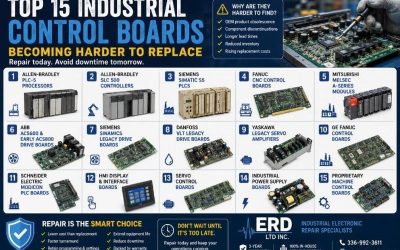
- Top 15 Industrial Control Boards Becoming Harder to Replace: which PLC processors and control boards are approaching the point where repair is the only option
- The Hidden Costs of OEM Discontinued Products: what happens when a failed PLC processor has no available replacement
- September Shutdown Checklist for Maintenance Managers: a practical inspection framework for PLC systems before Q4 production peaks
- How Severe Weather Damages Industrial Electronics: heat, surge, and contamination failure modes that apply directly to PLC hardware